
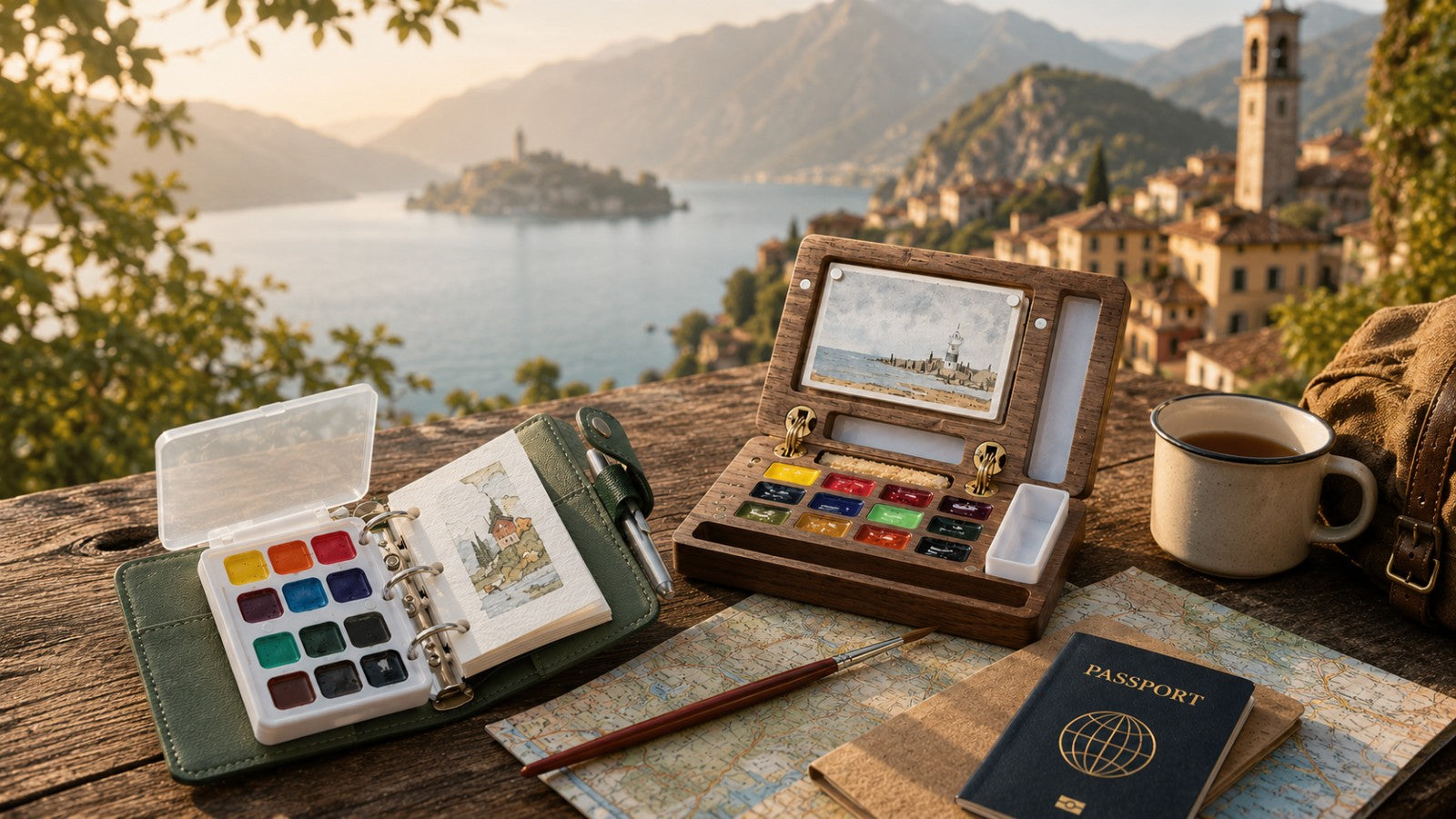
Quick answer: Plein air means painting outdoors from life. To start you need a compact all-in-one kit, water, and a way to work without a table. Keep paintings small, block in the big shapes fast (light changes quickly), and finish in 30–45 minutes. A complete travel kit like the Nomad or a tripod-ready Walnut Master Edition makes it easy.
“Plein air” (French for “open air”) simply means painting outdoors, from what’s in front of you. It’s how the Impressionists worked, and it’s the fastest way to improve — you learn to see light, simplify, and make decisions quickly. Here’s how to begin without the overwhelm.
What you need for plein air watercolor
- A compact, all-in-one kit — paints, brush, water pot and paper in one case, so nothing gets left behind. A pocket leather kit like the Nomad or the larger Voyager is ideal.
- Water — a refillable water pot or a small bottle. Many kits include a packable pot.
- A way to work table-free — a kit you can hold in one hand, a wrist kit, or a tripod-mounted station like the Master Edition.
- A hat, a clip and a cloth — shade for your eyes, a clip to stop pages flapping, a rag for your brush.
The biggest challenge: changing light
Outdoors, the light moves and shadows shift within the hour. The trick is to commit to the light you see in the first few minutes and stop chasing it. Block in your big shapes and shadow shapes fast, then refine. This is why plein air paintings are usually small — you can finish before the scene changes.
A simple 5-step process
- 1. Choose a small, simple view. Don’t paint everything — pick one focal point.
- 2. Sketch lightly. A few pencil lines to place the big shapes.
- 3. Paint the sky and big washes first (wet-on-wet for soft skies).
- 4. Build the mid-tones, then the darks last.
- 5. Stop early. Leave some white paper and rough edges — that freshness is the charm of plein air.
Tips that make outdoor painting easier
- Paint in the shade if you can — glare on white paper is blinding and distorts color.
- Use less water than indoors; paint dries faster in sun and wind.
- Keep a “done” mindset — a finished small study beats an overworked big one.
- Bring a refill of paper so a good session never ends early.
Frequently asked questions
What is plein air painting?
Plein air is painting outdoors, directly from a real scene rather than a photo. It’s popular in watercolor because the kit is so portable.
What do I need to start plein air watercolor?
A compact all-in-one kit (paint, brush, water pot, paper), something to work on without a table, and basics like a clip and a cloth. An all-in-one travel kit covers most of this in one case.
How do you deal with changing light outdoors?
Commit to the light you see in the first few minutes, block in your big shapes and shadows quickly, and keep the painting small so you can finish before the scene changes.
Do I need an easel for watercolor plein air?
No. Many painters just hold a compact kit. If you prefer to stand, a tripod-mountable kit like the Walnut Master Edition or a wrist kit removes the need for a table.
How long should a plein air painting take?
Usually 30–45 minutes. Working small and fast is part of the discipline — and the freshness.

Hinterlasse einen Kommentar
Diese Website ist durch hCaptcha geschützt und es gelten die allgemeinen Geschäftsbedingungen und Datenschutzbestimmungen von hCaptcha.